How Do Scientists Measure Changes in Humpback Whale Singing Activity Throughout the Season in Samaná Bay?
Humpback whales are known for their complex songs, which can change in structure and occur at different rates across their breeding season. In the waters around Samaná Bay in the Dominican Republic, seasonal whale activity attracts researchers, wildlife enthusiasts, and whale-watching visitors.
But how can scientists determine whether humpback whales are singing more frequently at one point in the season than another The answer involves more than counting sounds. Researchers need consistent acoustic recordings, reliable detection methods, carefully selected time periods, and a clear understanding of what singing activity can—and cannot—reveal about whale behavior.
Seasonal acoustic monitoring provides a useful way to investigate how whale vocal activity changes over time. It can also help scientists understand how environmental conditions and human-generated noise influence their ability to detect these sounds.
What Is Humpback Whale Singing Activity?
Humpback whale singing activity refers to the occurrence and distribution of song vocalizations within a defined period or location.
Scientists can describe this activity in several ways:
- The proportion of recording time during which song is detected.
- The number of song sequences detected per hour or day.
- The duration of detected singing episodes.
- The timing of singing throughout the day or season.
- Changes in the acoustic structure of songs over time.
- The proportion of usable recordings containing identifiable song.
These measurements describe different aspects of acoustic activity. For example, a longer singing episode does not necessarily mean more individual whales are present. Similarly, a higher number of detected song sequences does not automatically demonstrate an increase in the whale population.
A well-designed study selects measurements that match its research question and uses consistent definitions throughout the observation period.
1. Establishing a Seasonal Monitoring Schedule
The first step is deciding when and how often to collect recordings.
Researchers studying seasonal patterns may monitor a location repeatedly over several weeks or months. A study might use fixed hydrophones that record continuously, scheduled recording sessions, or a combination of stationary and mobile equipment.
Continuous monitoring can reveal short-term changes that occasional observations might miss. Scheduled recordings can reduce data-storage requirements, but they may miss brief periods of singing activity.
For a study in Samaná Bay, researchers could establish a monitoring schedule covering different phases of the locally observed whale season. The exact dates should be selected using reliable regional information and the research objectives rather than assumed to be identical every year.
Consistency is important. If one month contains substantially more recording hours than another, a simple comparison of total detected songs could be misleading.
Scientists should record the total monitoring time, missing data, equipment interruptions, and any changes to the recording schedule.
2. Using Hydrophones to Capture Whale Songs
Hydrophones are underwater acoustic sensors that allow researchers to record sound beneath the surface.
Depending on the project, a hydrophone may be attached to a stationary mooring, deployed from a research vessel, or included in an array of sensors. Each arrangement has advantages and limitations.
A stationary hydrophone can monitor the same general area over an extended period. This is useful for comparing acoustic activity across dates because the recording location remains relatively consistent.
A mobile hydrophone can help researchers investigate different parts of the bay, although changes in location make direct comparisons more complicated.
Researchers must also consider equipment sensitivity, recording settings, sensor depth, and environmental conditions. These factors influence which sounds are captured and how clearly they can be identified.
Importantly, acoustic monitoring detects sounds reaching the sensor, not every whale in the surrounding water.
3. Measuring the Percentage of Time Spent Singing
One practical measure is the proportion of usable recording time during which humpback whale song is detected.
For example, suppose researchers analyze 10 hours of usable audio and identify song during 3 hours. The detected song-positive time is 30% of the monitoring period.
The calculation is:
Song-positive time percentage = (time containing detected song ÷ total usable recording time) × 100
This measure allows researchers to compare sessions of different lengths, provided that recording quality and detection procedures are sufficiently consistent.
However, the result represents the proportion of time when song was detected under the study conditions. It does not necessarily represent the percentage of whales that were singing.
Several whales may sing simultaneously, while one whale may produce song across multiple recording intervals. The hydrophone may also detect song from animals outside the immediate observation area.
4. Counting Song Sequences and Singing Episodes
Researchers can also measure the number of identifiable song sequences or singing episodes within a defined interval.
To do this reliably, the study needs a consistent rule for defining the beginning and end of an episode. For example, analysts might use a predetermined silence interval to separate episodes, depending on the acoustic characteristics and study design.
The number of detections can then be expressed as sequences per hour, episodes per recording session, or another suitable rate.
These measures are useful for identifying changes in the frequency of detected singing events. However, overlapping songs can complicate counting, and a long sequence may contain many repeated units without representing many individual singers.
Researchers should avoid comparing counts produced by different detection rules without checking whether those rules are compatible.
5. Analyzing Spectrograms for Seasonal Patterns
A spectrogram displays the frequency content of a sound over time. It allows analysts to inspect the tonal contours, repeated units, and sequences that may characterize humpback whale songs.
Researchers can use spectrograms to identify song-positive intervals and examine whether recognizable acoustic patterns recur across recording sessions.
Comparisons may reveal changes in the structure of song units, the order of phrases, or the prevalence of particular patterns within a dataset.
Humpback whale songs can also change over time, so scientists should not assume that every recording will contain an identical pattern. A classification system that works well early in the season may require careful review if the acoustic patterns change later.
Automated detection can help process large recordings, but the results should be checked for false detections and missed songs, especially when background noise is substantial.
6. Distinguishing Real Changes From Detection Problems
One of the greatest challenges in seasonal monitoring is determining whether a change in detected song reflects a change in whale vocal activity or simply a change in recording conditions.
For example, a noisy recording period may contain fewer identifiable songs even if whales continue vocalizing at a similar rate. Strong winds, waves, vessel activity, sensor problems, or changes in sound propagation can affect detection.
Researchers can address these problems by documenting:
- The number of usable recording hours.
- Background noise levels and major noise sources.
- Hydrophone position and operating condition.
- Weather and sea conditions where relevant.
- The detection criteria and analysis software used.
- Periods of missing or unusable data.
If recordings from one period are substantially noisier than those from another, scientists may need to exclude some intervals, apply validated detection corrections, or account for recording quality in their statistical analysis.
Simply comparing raw counts without evaluating detectability can lead to incorrect conclusions.
7. Comparing Different Phases of the Whale Season
A seasonal study can divide observations into defined periods, such as early, middle, and late phases of the monitoring season.
Researchers can then compare standardized measures of singing activity across these periods.
For example, a study might find that the proportion of recording time containing detected song is higher during the middle period than at the beginning. That finding would describe the monitored acoustic pattern.
It would not, on its own, establish why the pattern occurred.
Possible explanations could include changes in the number of singing whales, the amount of time individual whales spend singing, movement of animals into or out of the monitored area, or differences in acoustic detection.
To investigate these possibilities, researchers may combine acoustic data with visual surveys, photo-identification records, vessel observations, or other independent information.
Seasonal comparisons should also be repeated across years when possible. A pattern observed during one season may not represent the typical pattern for Samaná Bay.
8. Investigating Daily and Nightly Singing Patterns
Seasonal change is not the only pattern scientists can study. Singing activity may also vary by time of day.
Researchers can divide recordings into consistent time blocks and calculate song detections per hour or the proportion of each block containing song. Time zones, daylight-saving differences where relevant, and local clock conventions should be handled consistently.
If a study detects more song at night than during the day, analysts should investigate whether the difference remains after accounting for recording quality, noise, and other relevant factors.
A single day's results are rarely enough to establish a dependable daily pattern. Repeated sampling across multiple days and different stages of the season provides stronger evidence.
Researchers should also distinguish local clock time from the timing of environmental events if those events are important to the question being investigated.
9. Accounting for Multiple Whales Singing at Once
Several humpback whales may vocalize within the same acoustic environment. When their songs overlap, a single recording can contain sounds from multiple animals.
This creates an important challenge: the number of detected songs is not necessarily the number of singing whales.
Researchers may use spatially separated hydrophones, synchronized recordings, acoustic localization methods, or visual observations to investigate how many sound sources may be present. These techniques have their own limitations, especially when whales move or the underwater environment affects signal transmission.
Without suitable evidence, analysts should report acoustic detections rather than claiming to know the exact number of singers.
This distinction is essential when comparing singing activity with whale abundance.
10. Using Statistical Methods to Compare Seasonal Activity
Once recordings have been processed, researchers can use statistical methods to determine whether observed differences are consistent with a seasonal pattern or may reflect random variation.
The appropriate method depends on the data. Song-positive time may be analyzed as a proportion, while sequence counts may require count-based models. Repeated measurements from the same sensor and observations from different locations may also need to be accounted for.
A robust analysis considers factors such as:
- Unequal recording effort.
- Changes in background noise.
- Repeated observations from the same site.
- Seasonal and daily variation.
- Uncertainty in song classification.
- Differences among monitoring locations and years.
Researchers should report the size of the observed difference and its uncertainty, not just whether a statistical test crosses a conventional significance threshold.
Statistical evidence can identify patterns in the recordings, but interpreting their biological cause requires additional reasoning and, where possible, independent evidence.
11. Connecting Singing Activity With Whale-Watching and Conservation
Acoustic monitoring can contribute to conservation by helping researchers investigate when biological sounds occur and how vessel noise may affect their detection.
For example, researchers could compare song-positive recording time during periods with different levels of vessel activity. They would need to consider background noise, recording locations, and other factors before interpreting any association.
If fewer songs are detected during noisy periods, several explanations remain possible. Noise may mask the sounds, whales may alter their vocal behavior, or the distribution of whales may change. A simple acoustic comparison cannot always distinguish among these possibilities.
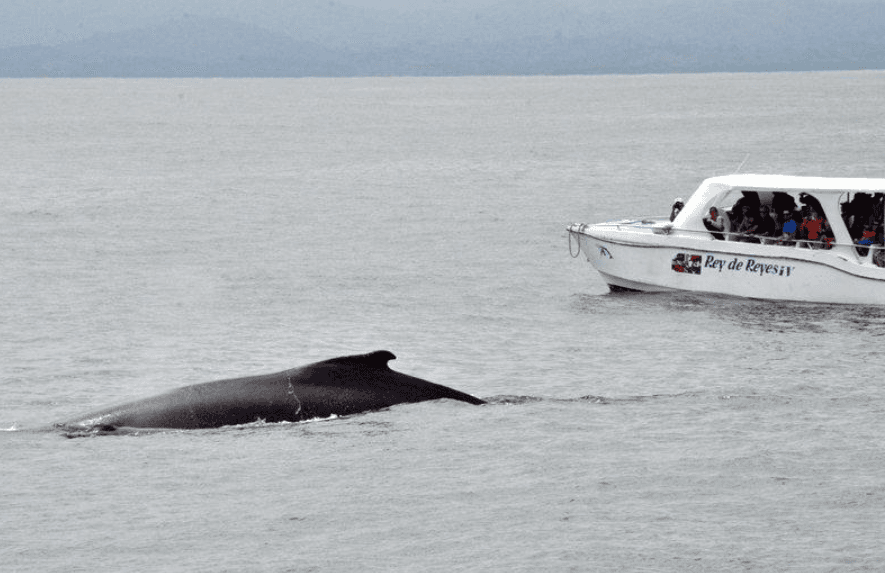
Responsible whale-watching practices and adherence to local wildlife regulations can help limit avoidable disturbance. Researchers can also improve the usefulness of monitoring programs by recording vessel activity and environmental conditions alongside acoustic measurements.
These approaches provide a framework for studying human activity and whale communication without assuming that every observed difference represents a behavioral response.
12. What Seasonal Acoustic Monitoring Can Tell Us About Samaná Bay
A carefully designed monitoring program could help describe the timing, duration, and distribution of detected humpback whale song in Samaná Bay.
It could also support comparisons among locations, monitoring periods, and years. Over time, a consistent dataset may help researchers identify recurring acoustic patterns and formulate questions for further investigation.
However, conclusions must remain within the limits of the evidence. A change in detected singing does not automatically mean that the number of whales has changed, that individual whales have altered their behavior, or that a particular environmental factor caused the difference.
Specific claims about singing trends in Samaná Bay require verified local recordings and documented analysis. General knowledge about humpback whale behavior is not a substitute for regional acoustic data.
Conclusion
Scientists measure seasonal changes in humpback whale singing activity by collecting consistent underwater recordings, identifying song sequences, calculating standardized detection rates, and comparing results across time.
The most useful studies account for background noise, unequal recording effort, overlapping singers, and changes in detectability. They also distinguish acoustic activity from the number of whales present.
For Samaná Bay, these methods offer a scientific framework for studying whale communication throughout the season. Reliable conclusions depend on sustained monitoring, transparent analysis, and evidence that supports the specific claim being made.
Frequently Asked Questions
Do humpback whales sing throughout the entire breeding season?
Singing activity can vary over time, and not every whale vocalizes continuously. The pattern depends on the animals, context, and conditions. A specific seasonal pattern for Samaná Bay should be established through local observations.
How do scientists measure how often whales sing?
They may calculate the number of detected song sequences per hour, the duration of singing episodes, or the percentage of usable recording time containing song.
Does more recorded whale song mean more whales are present?
Not necessarily. The difference could reflect changes in singing behavior, overlapping vocalizations, whale movement, or sound detectability. Independent evidence is needed to estimate abundance.
Can hydrophones monitor whales when they cannot be seen?
Yes. Hydrophones can record underwater vocalizations when whales are submerged or outside visual range, although the sensors only capture sounds that reach them clearly enough to detect.
Why do scientists compare multiple seasons?
Repeating measurements across seasons helps researchers determine whether an observed pattern recurs or was specific to one monitoring period. Multi-year comparisons can also reveal variation between seasons.
Can boat noise affect seasonal whale-song measurements?
Yes. Vessel noise can mask vocalizations and reduce the number of songs detected. Researchers should document noise conditions and account for detection limitations before interpreting seasonal differences.

Local explorer & expert guide in Los Haitises Park Tours.