How Humpback Whales Use Their Senses to Navigate the Ocean
The ocean is a constantly changing environment filled with sounds, moving water, shifting light, and other marine animals. For humpback whales, understanding this environment is essential for finding food, interacting with other whales, traveling across vast distances, and responding to potential dangers.
During whale-watching season in Samaná Bay, Dominican Republic, visitors may see humpback whales surfacing, swimming, or moving through the water. Although these encounters reveal only a small part of a whale's life, they provide an opportunity to learn about the sensory abilities that help these animals survive.
Humpback whales do not experience the ocean exactly as humans do. Their hearing is particularly important underwater, while their vision and sense of touch also contribute to how they interact with their surroundings.
In this guide, we explore what scientists know about humpback whale senses, how these abilities support life in the ocean, and what remains uncertain about the way whales perceive their world.
Why Are Senses Important to Humpback Whales?
A whale lives in an environment where visibility can change quickly, light becomes weaker with depth, and sound travels differently than it does through air.
Sensory information helps whales respond to their surroundings. They need to locate prey, maintain contact with other whales, detect changes in their environment, and orient themselves during travel.
Different senses serve different purposes. Hearing is particularly useful because sound travels efficiently underwater. Vision can help whales observe nearby animals and objects, while touch may play a role in physical contact and interactions.
Scientists study these abilities through observations of whale behavior, anatomical research, acoustic recordings, and other methods. However, some aspects of whale perception remain difficult to investigate because humpbacks spend much of their lives underwater.
1. Hearing: An Essential Sense Underwater
Sound is one of the most important ways humpback whales receive information from their environment.
Underwater, sound can travel over considerable distances, depending on factors such as frequency, water conditions, and background noise. This makes hearing valuable in an environment where visual contact may be limited.
Humpback whales produce a variety of sounds, including songs and shorter vocalizations. Researchers have studied these sounds to understand communication, social behavior, and the role of acoustics in whale life.
How Does Hearing Help Humpback Whales?
Hearing may help humpback whales detect sounds from other whales and respond to their acoustic environment.
Sound can provide information even when another animal is not visible. However, researchers cannot automatically determine what a whale understands from every sound it hears.
The exact function of individual vocalizations may depend on the context in which they occur. Scientists continue to investigate how humpback whales interpret sounds and how different acoustic signals relate to their behavior.
Can Humpback Whales Hear Boats?
Humpback whales can be exposed to sounds produced by vessels and other human activities. Boat engines and underwater noise may overlap with parts of the acoustic environment whales use.
The effects depend on the sound's characteristics, intensity, duration, and surrounding conditions. Noise may sometimes interfere with communication or cause changes in behavior.
This is one reason responsible whale watching matters. Tour operators should follow applicable regulations and wildlife-viewing guidance, operate appropriately around whales, and avoid unnecessary disturbance.
2. Vision: Seeing in a Changing Marine Environment
Although hearing is especially important underwater, humpback whales also have eyes and use vision to observe their surroundings.
Water affects the way light travels. Visibility can be reduced by depth, suspended particles, weather, and other environmental conditions. As a result, the visual environment available to a whale can differ considerably from what a person experiences on land.
A humpback whale's eyes are adapted to its marine environment, allowing it to receive visual information while swimming and surfacing.
What Can Vision Help a Whale Do?
Vision can help a whale observe nearby animals and objects, respond to its immediate surroundings, and maintain visual contact under suitable conditions.
It may also contribute to interactions between whales, particularly when animals are close enough to see one another.
However, scientists cannot assume that humpback whales see the world in the same way humans do. Their visual capabilities and perception of colors, details, and contrast are different areas of biological investigation.
Can Humpback Whales See Boats?
A whale may be able to see a vessel when visibility and distance allow, but the details depend on the conditions.
It is not possible to determine from a surface encounter exactly what a whale sees or understands about a boat. Its response may involve several kinds of sensory information rather than vision alone.
Visitors should never interpret a whale's calm behavior as proof that it has not noticed a vessel. Maintaining a respectful distance is important regardless of whether the animal appears to react.
3. Touch: Detecting Physical Contact
Touch is another sensory ability that can matter in the lives of marine mammals.
Humpback whales have skin and sensory structures that allow them to receive information through physical contact. Contact with another whale or an object can provide information about the immediate environment.
The tubercles on a humpback whale's head contain hair follicles. These structures are scientifically interesting, but their full sensory roles should not be overstated without evidence.
Why Might Touch Matter?
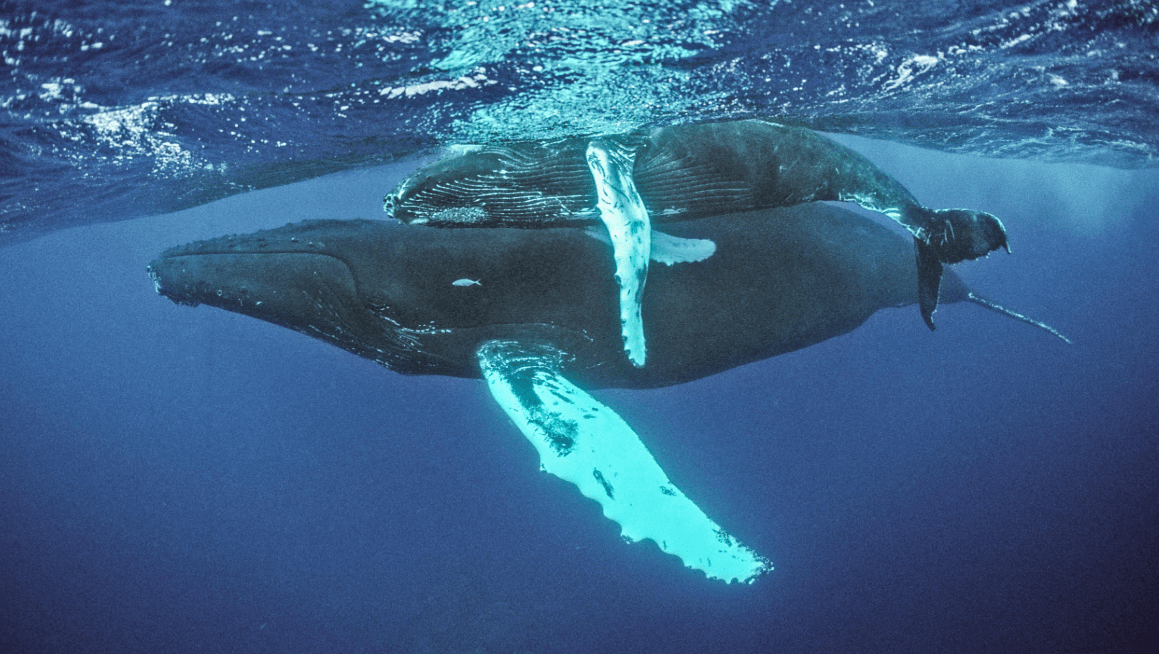
Physical contact may occur during close interactions between whales. A calf, for example, remains near its mother during early life, and the pair may come into contact as they move.
Touch can also be relevant when a whale encounters its surroundings, although the specific sensory information gained from each interaction is not always known.
Researchers continue to investigate the sensory biology of whales. It is important to distinguish observations of contact from conclusions about exactly what an animal feels or understands.
4. Smell and Taste: What Do Scientists Know?
Smell and taste are familiar senses for humans, but their roles in humpback whale behavior are less straightforward than hearing and vision.
The sensory systems of cetaceans have changed through their evolutionary history as their ancestors adapted to aquatic life. Different whale groups have different anatomical features, so findings about one species should not automatically be applied to another.
Humpback whales have a respiratory system adapted for breathing air through blowholes, and their olfactory abilities are not considered equivalent to those of typical land mammals.
Taste and chemical sensing in cetaceans are also areas where broad claims should be treated cautiously. The extent to which humpbacks use chemical cues for particular behaviors is not fully established.
Can Humpback Whales Smell Their Environment?
It would be misleading to describe humpback whales as having the same smell-based experience as humans or dogs.
Researchers investigate cetacean sensory anatomy to understand which systems are present and how they function. However, the importance of chemical cues for particular humpback whale behaviors remains less clearly understood than the role of hearing.
For this reason, a responsible educational guide should acknowledge uncertainty rather than claim that humpbacks use smell to locate distant food or navigate long migrations without strong evidence.
5. How Do Humpback Whales Orient Themselves During Migration?
North Atlantic humpback whales travel between feeding grounds at higher latitudes and breeding areas in the Caribbean, including Samaná Bay.
These journeys can cover thousands of kilometers. They raise an important question: how do whales maintain their orientation across such large ocean areas?
Researchers have investigated several possible navigation mechanisms in cetaceans, including environmental cues, memory, and sensitivity to features of the surrounding environment.
However, the precise combination of mechanisms used by humpback whales during long-distance migration is not completely understood.
Do Whales Use Earth's Magnetic Field?
Magnetic navigation has been proposed as a possible mechanism in some migratory animals, and researchers have investigated whether it may contribute to navigation in cetaceans.
Nevertheless, it is important not to present magnetic navigation as a fully established explanation for how humpback whales find their way to Samaná Bay.
Long-distance migration may involve several interacting mechanisms. More research is needed to establish the relative importance of different cues for humpback whales under natural conditions.
Their migration remains a remarkable example of animal movement, even though scientists are still working to understand all the processes involved.
6. How Do the Senses Work Together?
A whale's sensory abilities do not operate in isolation. Information from hearing, vision, touch, and other sensory systems can contribute to its response to the environment.
Imagine a humpback whale swimming near the surface. It may receive sounds from the surrounding water, see nearby objects under suitable conditions, and sense water movement around its body.
The animal's response may reflect a combination of these inputs rather than a single sense.
Scientists study whale behavior to understand these relationships, but observing a whale from a boat rarely reveals exactly which sensory information influenced a particular movement.
This is an important distinction between describing behavior and explaining its underlying cause.
7. Can Whale-Watching Visitors Observe These Senses in Action?
A whale-watching trip in Samaná Bay offers an opportunity to observe humpback whales in their natural environment, but visitors cannot directly see or measure the animals' sensory experiences.
Instead, you can observe behaviors that provide clues about how whales interact with the world.
For example:
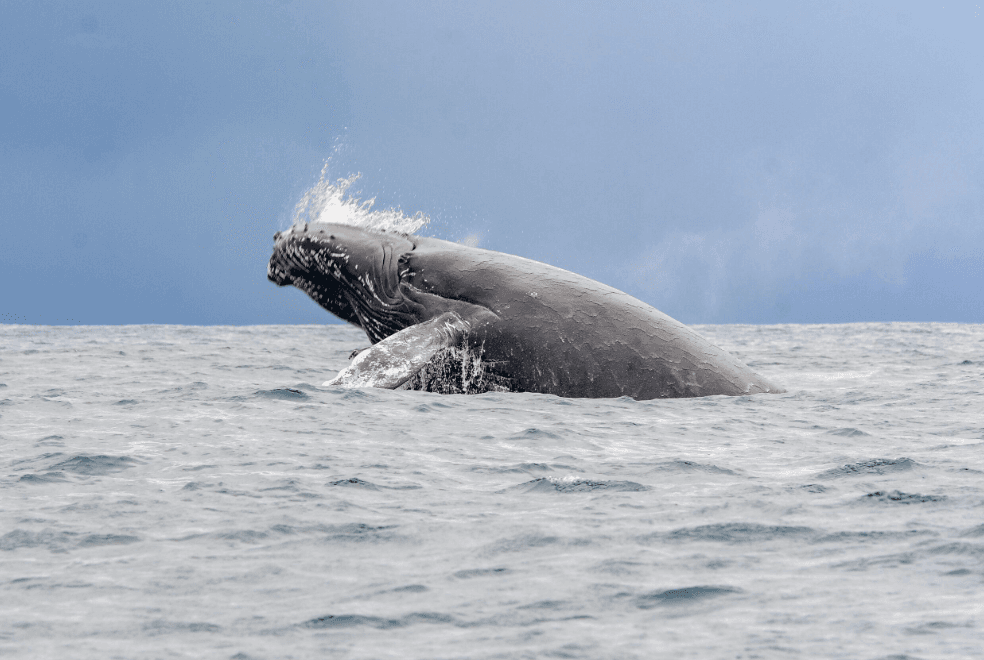
- Surfacing: A whale comes to the surface to breathe and may expose part of its head or back.
- Swimming near another whale: The animals may remain in visual proximity or respond to one another's movements.
- Changing direction: A whale alters its course, although the reason cannot usually be determined from the movement alone.
- Producing sounds: Some whale vocalizations can be recorded with appropriate underwater equipment, even when they cannot be heard clearly from the boat.
- Responding to nearby activity: A whale may change its behavior, but the precise stimulus responsible is not always apparent.
These observations can help visitors appreciate the complexity of whale behavior without assuming they can determine what an animal is sensing at every moment.
8. How Scientists Study Whale Senses
Studying the sensory abilities of a large, free-swimming marine mammal presents unique challenges. Researchers cannot easily observe the whale continuously, and many important behaviors occur underwater.
Scientists use different methods depending on the question they want to investigate.
Acoustic Research
Hydrophones are underwater microphones that allow researchers to record whale sounds and other underwater noise.
These recordings help scientists study vocalizations, sound patterns, and the acoustic environments whales inhabit. Acoustic monitoring can also help researchers understand how human-generated noise overlaps with whale sounds.
However, recording a sound does not automatically reveal its meaning. Interpretation requires careful analysis and, where possible, comparisons with observed behavior.
Behavioral Observation
Researchers may observe whales from vessels or other appropriate platforms and record their movements, interactions, and responses to environmental conditions.
These observations can reveal patterns, but they do not always establish cause and effect. A whale may change direction for several possible reasons, and an observer may not have enough information to distinguish between them.
Anatomical and Physiological Research
Anatomical studies help scientists understand the structures associated with hearing, vision, touch, and other sensory systems.
Research findings from other cetaceans can sometimes provide useful comparisons, but scientists must be careful when applying them to humpback whales specifically.
Together, these approaches improve our understanding of how whales perceive and respond to their environment.
9. Why Understanding Whale Senses Matters for Conservation
Understanding whale senses has practical importance for marine conservation.
If whales depend on sound to receive information from their surroundings, underwater noise may affect the way they communicate or respond to other animals. The magnitude of the effect depends on the circumstances and the type of noise involved.
Research into whale behavior and sensory biology can help inform conservation measures, vessel practices, and the management of human activities in important whale habitats.
For visitors to Samaná Bay, the lesson is simple: whales are active animals receiving information from a complex environment, even when their behavior appears calm or uneventful.
Responsible wildlife tourism recognizes that these animals need space to move and behave naturally.
Frequently Asked Questions
Which sense is most important to humpback whales?
Hearing is particularly important in the underwater environment because sound travels efficiently through water and humpbacks use acoustic signals. However, vision, touch, and other sensory processes also contribute to their interactions with the environment.
Can humpback whales see clearly underwater?
Humpback whales have eyes adapted to marine life, but underwater visibility varies with depth, light, and water conditions. Their visual experience is not identical to that of humans.
Can humpback whales hear sounds from far away?
Sound can travel long distances underwater, but the distance at which a whale detects a particular sound depends on its frequency, intensity, background noise, and environmental conditions. There is no single detection distance that applies to every sound.
Do humpback whales use smell to find food?
The role of smell and other chemical cues in humpback whale behavior is not as well established as their use of acoustic signals. It is best to avoid claiming that smell is the main method they use to locate prey.
Do humpback whales use Earth's magnetic field to navigate?
Magnetic navigation has been proposed as a possibility for some cetaceans, but its precise role in humpback whale migration is not fully established.
Can visitors hear whale sounds during a Samaná whale-watching trip?
Not necessarily. Many whale sounds are underwater and may not be audible to passengers. Researchers commonly use hydrophones to record and study these sounds.
Final Thoughts
Humpback whales live in an environment where sound, light, physical contact, and other environmental information can influence how they interact with the world.
Their hearing is especially important underwater, while vision and touch also contribute to their sensory experience. Scientists continue investigating how these abilities work together and how humpbacks navigate their extensive migrations.
During a whale-watching trip in Samaná Bay, visitors can observe the animals' movements and learn from knowledgeable guides, even though the whales' sensory experiences remain largely hidden from view.
The more we understand about how humpback whales perceive their environment, the better equipped we are to appreciate their behavior, respect their needs, and support the conservation of the marine habitats on which they depend.

Local explorer & expert guide in Los Haitises Park Tours.