How Do Scientists Identify Different Sections Within a Humpback Whale Song?
Humpback whales are famous for their complex underwater vocalizations. During the breeding season, their songs can contain repeated sounds, changing patterns, and sequences that develop over time. To understand these vocal displays, scientists need to determine how individual sounds are organized into larger structures.
Identifying the different sections of a humpback whale song helps researchers describe its organization, compare recordings, and investigate how songs change. It is also an important part of marine bioacoustics, the scientific study of sound produced and transmitted underwater.
For visitors interested in Samaná whale watching in the Dominican Republic, this subject offers another way to appreciate humpback whales. The animals are not simply making isolated noises; their vocalizations can form structured acoustic sequences that scientists analyze systematically.
What Is the Structure of a Humpback Whale Song?
Researchers commonly describe humpback whale songs at several organizational levels. The terminology and precise classification rules can vary between studies, but a simplified framework includes units, phrases, and larger song sequences.
1. Song units
A song unit is an individual acoustic element that researchers distinguish by its sound characteristics. It may be a short tonal sound, a rising or falling frequency sweep, a pulse, or a more complicated vocalization.
Scientists examine features such as frequency, duration, pitch contour, and the presence of repeated pulses to describe each unit.
2. Phrases
A phrase is a sequence of units arranged in a recognizable pattern. Some units may occur repeatedly, while others appear in a relatively consistent order.
Researchers identify phrases by examining both the sounds themselves and how they are arranged over time.
3. Themes and larger sequences
In many descriptions of humpback whale song, repeated phrases are organized into larger sections commonly called themes. Several themes may occur in a broader sequence that researchers describe as a song.
These levels are useful analytical categories rather than proof that whales understand their songs in exactly the same way humans understand musical compositions.
Why Do Scientists Divide Whale Songs Into Sections?
Listening to a long recording without classifying its components makes systematic comparison difficult. Dividing the recording into sections gives researchers a repeatable way to describe what they hear.
This approach helps scientists:
- Identify recurring acoustic patterns.
- Compare song organization across recordings.
- Detect changes in phrase order or sound characteristics.
- Measure how frequently particular units or phrases occur.
- Investigate similarities between songs recorded at different times or locations.
- Develop consistent datasets for further acoustic analysis.
The resulting classifications can support research into whale communication and vocal learning. However, identifying a pattern does not automatically reveal what that pattern means to the whale.
How Do Researchers Identify Song Units?
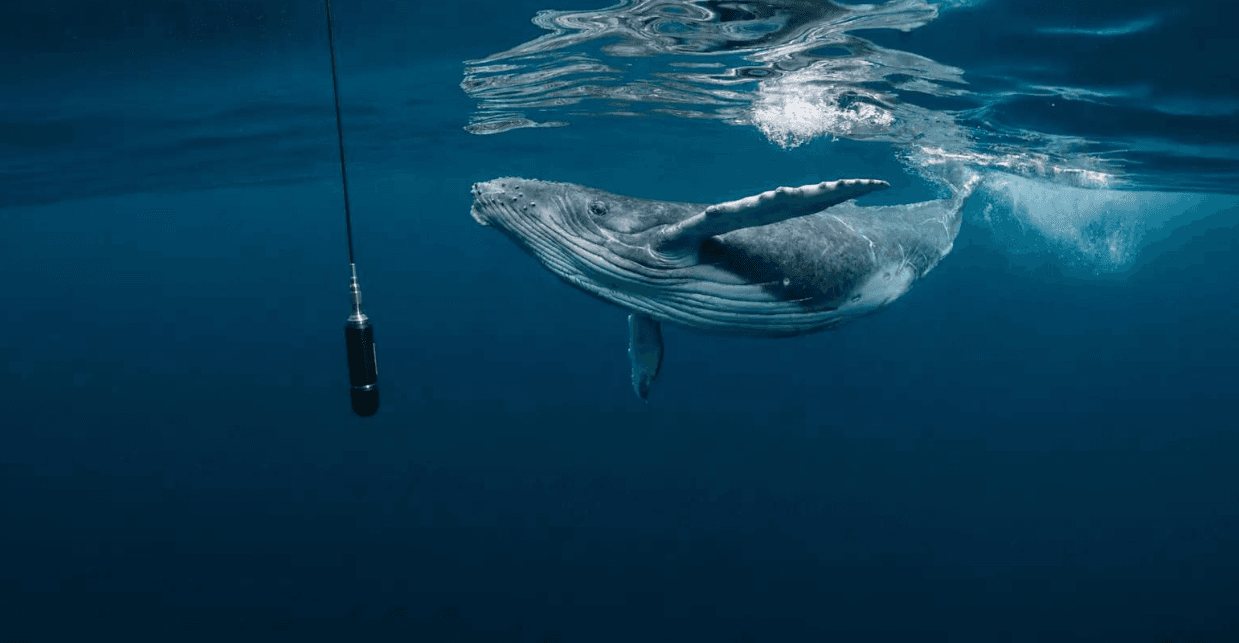
The process usually begins with a clear underwater recording. Scientists may use hydrophones, which are microphones designed to detect sound underwater, to collect vocalizations for analysis.
They then listen to the recording and inspect its visual representation.
Listening to individual sounds
Researchers listen for changes in pitch, tone, rhythm, and sound quality. They may replay a short segment several times to determine where one recognizable acoustic event ends and another begins.
Repeated listening can reveal differences that are difficult to notice when hearing an entire song at once.
Examining spectrograms
A spectrogram displays sound frequency over time, with signal intensity represented visually. It helps researchers inspect patterns such as frequency sweeps, tonal components, harmonics, and pulses.
For example, a sound that rises in frequency may produce a different visual pattern from a sound that falls in frequency. These differences can help researchers distinguish candidate units.
A spectrogram is an analytical aid, not an automatic answer. Background noise, overlapping calls, recording quality, and changes in sound amplitude can make classification difficult.
Creating consistent labels
Once a candidate unit has been identified, researchers assign it a label or category. The label might be a letter, number, or descriptive code.
The purpose is to make the classification consistent across the recording and across different observers. A useful classification system should explain which acoustic features distinguish one category from another.
How Do Scientists Recognize a Phrase?
After identifying individual units, researchers examine their order and repetition.
Suppose a recording contains a sequence represented as A–B–B–C. If the same arrangement occurs repeatedly, researchers may classify it as a recurring phrase, provided it meets the study's classification criteria.
A different sequence, such as A–C–D, might be classified separately if its structure is sufficiently distinct.
These letter labels are illustrative only; they do not represent a verified sequence recorded in Samaná Bay.
Researchers also consider timing. The interval between sounds, pauses within a sequence, and the repetition of particular units may help distinguish one phrase from another.
However, not every pause marks the beginning of a new phrase. Scientists must evaluate timing together with the acoustic pattern and the definitions established for their study.
How Are Larger Sections Identified?
Larger sections are identified by examining repeated phrases and their relationships across a longer recording.
A researcher may observe that a particular phrase recurs several times before another recognizable phrase becomes dominant. If the sequence fits the study's criteria, the phrases may be grouped into a broader theme.
Scientists then examine whether themes repeat, change order, or transition into other sections.
This process requires care because real recordings are not always perfectly organized. A whale may alter a phrase, produce an incomplete sequence, pause for an extended period, or vocalize while other sounds are present.
Researchers therefore need explicit rules for deciding whether a variation belongs to an existing category or should be treated as a distinct pattern.
What Tools Help Analyze Whale Song Structure?
Several tools can support the identification process.
Hydrophones: These capture underwater sound and provide the recordings used for acoustic analysis.
Audio analysis software: Researchers use software to listen to recordings, select segments, measure timing, and inspect frequency characteristics.
Spectrograms: These visual displays help reveal differences between acoustic units and repeated sequences.
Annotation systems: Researchers use labels, timestamps, and structured notes to record where units, phrases, and larger sections occur.
Statistical analysis: Once recordings have been classified, researchers can measure how frequently categories occur and compare song organization across samples.
Automated sound-classification tools may help identify candidate patterns in large datasets. Their results still require validation because background noise, overlapping vocalizations, and previously unseen sounds can produce classification errors.
How Do Scientists Make Their Classifications Reliable?
Two researchers might interpret an ambiguous sound differently. One may consider it a variation of an existing unit, while another may classify it as a new category.
To reduce this problem, researchers define classification rules before analyzing large datasets whenever practical.
They may compare independent annotations, discuss disagreements, and calculate measures of agreement. They can also review a sample of recordings repeatedly to determine whether the same rules produce consistent results.
If an acoustic event cannot be classified confidently, recording it as uncertain may be more scientifically appropriate than forcing it into a category.
Researchers should also document recording conditions and processing methods. Filters, changes in playback speed, and other processing steps can influence how a sound appears or is perceived.
Can Song Sections Change Over Time?
Yes. Humpback whale songs are not necessarily identical from one recording to the next.
Researchers may investigate changes in individual units, phrase structure, repetition, or the order of larger sections. Comparisons across dates or breeding seasons can help reveal whether particular patterns remain stable or change.
However, apparent differences can also arise from recording conditions, background noise, incomplete recordings, or differences in classification. Scientists need to account for these factors before concluding that a whale's song has changed.
Long-term datasets are particularly valuable because they allow researchers to compare observations across multiple periods instead of drawing conclusions from a single recording.
What Can Song Structure Tell Us About Humpback Whale Communication?
Song structure provides evidence about how vocalizations are organized and repeated. Scientists can use these patterns to investigate vocal learning, changes in singing behavior, and similarities between songs recorded in different groups or regions.
If similar patterns appear in recordings collected at different locations, researchers can investigate whether those similarities reflect shared song traditions or other explanations. Establishing how a pattern spread requires additional evidence; acoustic resemblance alone does not prove direct social transmission.
Likewise, researchers should not assume that every song section has a specific meaning. Understanding the function of particular vocal patterns remains a separate scientific question from describing their structure.
How Does This Research Relate to Samaná Bay?
Samaná Bay in the Dominican Republic is a well-known destination for observing migrating humpback whales during the winter breeding season. Visitors may see whales surfacing, displaying their tails, or interacting at the surface. Much of their acoustic activity, however, occurs underwater and cannot be understood from visual observations alone.
Acoustic methods could help researchers investigate humpback whale vocalizations in and around Samaná Bay, provided suitable recordings and study designs are available.
To determine which song sections occur locally, scientists would need recordings collected under documented conditions. They would also need to account for the possibility that more than one whale is vocalizing and that boat noise or other underwater sounds may affect the data.
It is important not to assume that a particular song structure has been documented in Samaná Bay without a reliable local research source.
For whale-watching visitors, learning about song analysis adds a scientific dimension to the experience. It highlights how researchers can study whale communication even when the animals' sounds are not directly audible above the water.
Challenges in Identifying Humpback Whale Song Sections
Researchers face several practical challenges:
- Background noise: Boat engines and other sounds may obscure parts of a recording.
- Overlapping vocalizations: Sounds from different whales may be difficult to separate.
- Natural variation: The same general sound pattern may vary slightly between repetitions.
- Unclear boundaries: There may be no obvious point where one phrase or theme ends and another begins.
- Incomplete recordings: A recording may begin or end in the middle of a sequence.
- Observer differences: Different analysts may disagree about ambiguous examples.
A careful study documents these limitations and avoids claiming more certainty than the recordings support.
Frequently Asked Questions
What is a song unit in a humpback whale song?
A song unit is an individual acoustic element distinguished by characteristics such as frequency, duration, pitch contour, or pulse pattern.
What is the difference between a phrase and a theme?
A phrase is a recognizable sequence of song units. A theme is a larger section that can contain repeated or related phrases. Terminology and classification details may differ between studies.
Do scientists identify song sections by listening alone?
No. Researchers often combine listening with spectrogram analysis, timing measurements, annotation software, and classification rules.
Can computers identify humpback whale song sections?
Computer-based methods can help detect and classify acoustic patterns. Their accuracy depends on recording quality, training data, and validation by researchers.
Does every humpback whale sing the same song?
No. Song patterns can vary, and some populations or groups may share evolving song traditions. Scientists need comparative evidence to describe these relationships accurately.
Can visitors hear whale songs during a Samaná whale-watching trip?
Not necessarily. Whale songs travel underwater, and ordinary sightseeing conditions do not usually provide direct access to those sounds. Specialized hydrophones and playback equipment may be needed to listen to underwater recordings.
Conclusion
Identifying sections within a humpback whale song involves more than recognizing individual sounds. Scientists analyze acoustic units, examine how those units form repeated phrases, and investigate how phrases are organized into larger sections.
Hydrophones, spectrograms, annotation systems, and consistent classification rules make this work more systematic. Researchers must still account for noise, natural variation, incomplete recordings, and uncertainty when interpreting results.
For anyone interested in Samaná whale watching, understanding song structure reveals another layer of humpback whale behavior beyond what can be observed at the surface. With suitable local recordings and careful analysis, acoustic research can contribute to a more complete understanding of these remarkable marine mammals.

Local explorer & expert guide in Los Haitises Park Tours.