How Do Whale-Watching Guides Spot Humpback Whales on the Horizon?
When a humpback whale appears in the distance, an experienced whale-watching guide may notice it before anyone else on the boat. The guide might point toward a faint plume above the water, a dark shape moving between waves, or a brief splash that other passengers mistake for ordinary ocean movement.
Spotting whales is a skill built on observation, patience, and familiarity with marine wildlife. Guides learn to scan large areas of open water, recognize possible signs of a whale, and check whether an apparent sighting is genuine.
In Samaná Bay, Dominican Republic, these skills can make a whale-watching excursion more informative and enjoyable. Humpback whales spend much of their time underwater, so finding them often depends on noticing brief moments of activity at the surface.
This article explains how whale-watching guides search the horizon, which visual clues they look for, and how visitors can learn to recognize possible whale sightings themselves.
Why Is Spotting a Humpback Whale So Challenging?
Humpback whales are large animals, but their size does not mean they are always easy to see. Much of a whale's body remains underwater, and a surfacing event may last only a short time.
A whale might appear as a small dark shape far from the boat. It may surface once, disappear, and reappear somewhere else after spending time underwater.
Distance also changes how the animal looks. At a considerable distance, details such as the shape of its head or markings on its body may be impossible to distinguish.
The ocean creates additional visual distractions. Waves, floating material, seabirds, and patches of reflected light can all draw an observer's attention.
For these reasons, guides do not rely on one visual clue. They combine several observations and continue checking the area rather than assuming that every splash or dark shape is a whale.
How Do Guides Scan the Horizon?
One of the basic techniques is systematic scanning. Instead of looking randomly across the sea, a guide can divide the visible area into sections and examine each section in turn.
This approach helps reduce the chance of repeatedly looking at the same area while overlooking another.
Searching from near to far
A guide may scan the water relatively close to the vessel before looking farther toward the horizon. The exact viewing pattern depends on the boat, sea conditions, and the area being observed.
Nearby water can contain useful clues, but distant areas also deserve attention because whales may surface well beyond the vessel's immediate surroundings.
Looking beyond the most obvious movement
People naturally notice large splashes and sudden motion. Guides must also watch for subtler signs, such as a brief change in the water's surface or a narrow plume that appears and disappears.
A small visual clue may be worth checking, but it is not automatically proof of a whale.
Returning to promising areas
If a guide sees a possible blow or a brief glimpse of a dark back, the guide may continue observing that general direction to see whether another sign appears.
This is especially useful because humpback whales can surface more than once during a period of observation. A second sighting may help confirm what the first one suggested.
What Is a Whale's Blow, and Why Do Guides Watch for It?
A whale's blow is the visible plume produced when it exhales at the surface. Humpback whales breathe air through blowholes on top of their heads.
The visible plume is often described as a spout. It consists of exhaled air, water vapor, and droplets of water around the blowhole; it is not simply seawater being expelled from the lungs.
A blow can provide an important visual clue because it may be visible even when the whale's body is difficult to see.
However, the appearance of a blow can vary with viewing distance, wind, background conditions, and the angle from which it is observed. Not every blow will be equally noticeable.
Guides look for the plume in combination with other evidence. If a dark back appears shortly afterward in the same area, confidence in the identification may increase.
For visitors, the main lesson is to watch the water around a possible blow rather than looking only at the plume itself. The whale may become visible immediately afterward.
How Do Guides Recognize a Whale's Back?
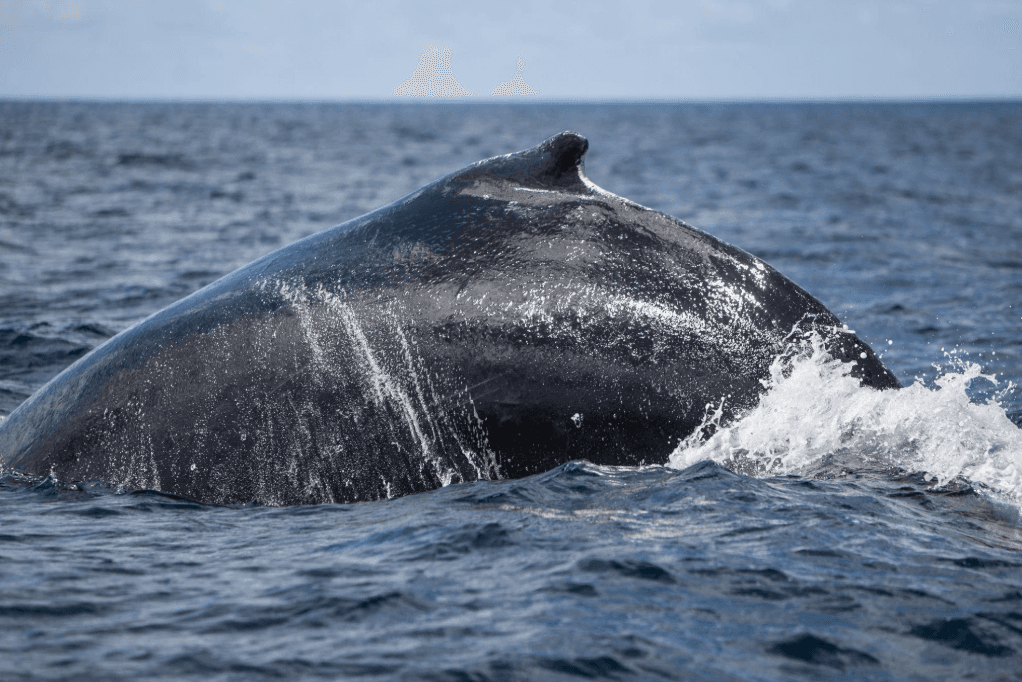
A humpback whale's back may appear as a dark, curved shape breaking the surface. Depending on the animal's movement, the visible section may rise gradually, roll forward, or disappear beneath the water.
At a distance, this shape can resemble a wave crest or another dark feature on the sea. Guides therefore pay attention to how the shape moves.
A wave crest generally follows the movement of the surrounding water. A whale's back may show a more coherent shape and a movement pattern consistent with an animal surfacing and submerging.
These distinctions are not always easy to see, particularly when the water is rough. Experienced observation improves the ability to notice useful details, but even a knowledgeable guide may need additional evidence before confirming a distant sighting.
Can a Whale's Tail Reveal Its Presence?
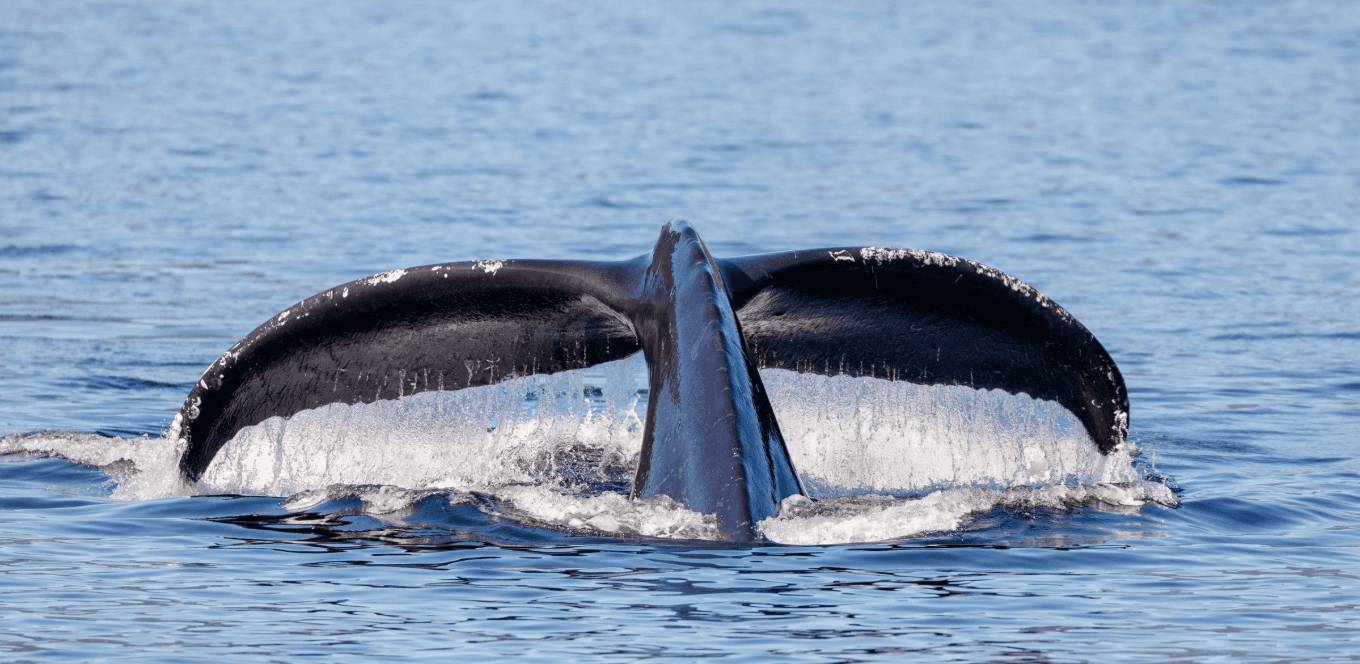
Yes. A humpback whale may lift its tail flukes above the surface before a deeper dive. When this happens, the tail can provide a distinctive visual sign.
However, tail lifting does not occur during every dive, and guides cannot assume that a whale will show its flukes on every surfacing sequence.
A raised tail may be visible for only a short time. By the time a passenger turns toward the guide's pointing direction, the animal may already be underwater.
This is why listening to the guide and looking in the indicated direction promptly can be helpful.
A visible tail is also different from identifying an individual whale. Recognizing that a tail belongs to a humpback whale is one task; matching its distinctive markings to a previously recorded individual requires a separate identification process.
How Do Guides Distinguish Whales From Waves and Splashes?
False alarms are a normal challenge when searching for wildlife over a large area.
Whitecaps can resemble splashes. Sunlight can create bright patches that change as the boat moves. Seabirds diving or taking off may produce sudden movement near the surface.
Guides evaluate the overall appearance of a possible sighting rather than focusing on a single detail.
They may ask:
- Does the shape have a recognizable animal-like outline?
- Does the movement continue in a way consistent with a whale surfacing?
- Is there a blow, a back, a tail, or another supporting clue?
- Does the same area show additional signs of a large marine animal?
- Could the apparent sighting be explained by waves, glare, or another natural feature?
No single question is decisive in every situation. The purpose is to combine clues and avoid confidently identifying something that has not been clearly observed.
A responsible guide should also acknowledge uncertainty when a distant sighting cannot be confirmed.
Why Do Experienced Guides Notice Things Passengers Miss?
Experience can improve visual attention. Guides who regularly observe marine wildlife become familiar with the appearance of common surface movements and the kinds of clues that deserve closer inspection.
They may notice a faint blow against the horizon or recognize a recurring pattern of movement that a first-time visitor has not learned to identify.
Experience also helps with attention management. Scanning the sea for long periods can be tiring, especially when there is little visible activity. A structured search pattern helps maintain concentration.
Nevertheless, experience does not give a guide the ability to see through the water or predict every surfacing event. Whales remain wild animals, and their movements cannot be controlled.
Guides may also work with other crew members who are watching different parts of the sea. Multiple observers can expand the area being monitored, although their observations still need to be interpreted carefully.
Do Guides Use Binoculars to Find Humpback Whales?
Binoculars can help observers examine a distant area more closely when visibility permits. They may be useful for checking a suspected blow, observing a dark shape, or distinguishing a possible animal from other surface features.
However, binoculars are not a substitute for systematic scanning. Magnification narrows the field of view, making it easier to lose track of where a whale surfaced if the observer begins looking through the binoculars without first locating the target.
A practical approach is to identify the general direction with the naked eye, raise the binoculars toward that area, and then return to a wider scan.
Visitors should use binoculars only when it is safe to do so. On a moving boat, maintaining balance and following crew instructions are more important than trying to obtain a closer view.
Not every whale-watching trip provides binoculars, so passengers who want to bring their own should check the operator's guidance and consider the conditions on the vessel.
How Does the Boat's Movement Affect Whale Spotting?
A guide's viewing position changes as the boat moves across the water. The vessel may rise and fall, turn, or change direction, altering the angle at which distant objects appear.
This movement can make it difficult to maintain visual contact with a whale that surfaces briefly.
The guide must also account for the vessel's direction and safe navigation. Searching for whales should never take priority over safe boat handling or applicable whale-watching rules.
Once a whale is sighted, the crew may communicate its direction to passengers. Clear instructions help everyone look toward the same area without crowding one side of the boat or obstructing the crew.
Passengers should remain in designated safe areas and avoid sudden movements that could affect their balance or the safety of others.
Can Visitors Learn to Spot Humpback Whales?
Yes. First-time whale watchers can improve their observation skills by learning a few basic techniques.
Start with a broad view. Look across the water rather than concentrating on one tiny spot. A broad scan helps you notice movement in different parts of the visible sea.
Learn the main clues. Watch for a blow, a dark back, a raised tail, or a splash that is followed by other signs of an animal.
Follow the guide's directions. If the guide points toward a particular area, look there promptly. The animal may surface only briefly.
Be patient. Whales do not follow a timetable that guarantees regular appearances. Several minutes of quiet observation may pass before another sign becomes visible.
Avoid assuming every splash is a whale. Waves and other natural events can be misleading. Listen to the guide's explanation before drawing conclusions.
Keep safety in mind. Stay seated or in the permitted observation area when required, and do not move suddenly to obtain a better view.
These techniques can make the trip more engaging even when a whale remains distant.
Why Is Responsible Observation More Important Than Finding a Whale Quickly?
Whale watching is an opportunity to observe wild animals, not to control their movements. A guide's job is to search carefully while respecting safety requirements and the rules designed to protect whales.
The appearance of a whale does not justify chasing it, obstructing its path, or approaching too closely. Responsible operators must follow applicable local regulations and guidance on vessel conduct and wildlife observation.
Visitors should also understand that no guide can guarantee a particular display, such as a tail lift or a breach. These behaviors depend on the whale, and the animal may remain mostly submerged during a sighting.
A good excursion combines informed observation with realistic expectations. Even a brief view of a whale can be meaningful when passengers understand what they are seeing and why the encounter should remain respectful.
Frequently Asked Questions
How do whale-watching guides find whales so quickly?
Guides may use systematic horizon scanning, recognize signs such as blows and surface movements, and share observations with other crew members. Their experience can help them notice clues that inexperienced observers overlook.
What is the easiest sign of a humpback whale to spot?
A visible blow can be a useful clue, particularly when the whale is some distance away. A dark back or raised tail may also reveal the animal, but no single sign is guaranteed to be visible every time.
Can guides spot whales before they surface?
Guides cannot reliably see a submerged whale through the ocean. They may observe an earlier surface sign or use knowledge of the animal's last location to watch an area, but a whale can move underwater and surface elsewhere.
Do whale-watching guides use special equipment?
Binoculars and communication equipment may help, depending on the operator and vessel. Careful observation remains important, and equipment does not guarantee a sighting.
Why do passengers sometimes miss a whale that the guide sees?
The whale may be distant, surface briefly, or appear in an unexpected direction. Passengers may also be looking elsewhere when the guide first notices it.
Are whale sightings guaranteed in Samaná Bay?
No. Humpback whales are wild animals, and their movements and surfacing behavior are unpredictable. A responsible operator should explain its actual policies without promising a guaranteed encounter.
Conclusion
Spotting humpback whales on the horizon requires patience, structured scanning, and the ability to recognize subtle visual clues. Whale-watching guides look for blows, dark backs, tail flukes, and patterns of surface movement while checking that an apparent sighting is not simply a wave or reflection.
Visitors can learn these skills, too. By following the guide's directions, scanning carefully, and staying patient, travelers can become more involved in the observation process.
During whale-watching season in Samaná Bay, the most rewarding approach is to combine curiosity with respect for wildlife. A guide can help you notice the signs, but every sighting remains an encounter with a wild animal whose next movement cannot be guaranteed.

Local explorer & expert guide in Los Haitises Park Tours.